
modern times
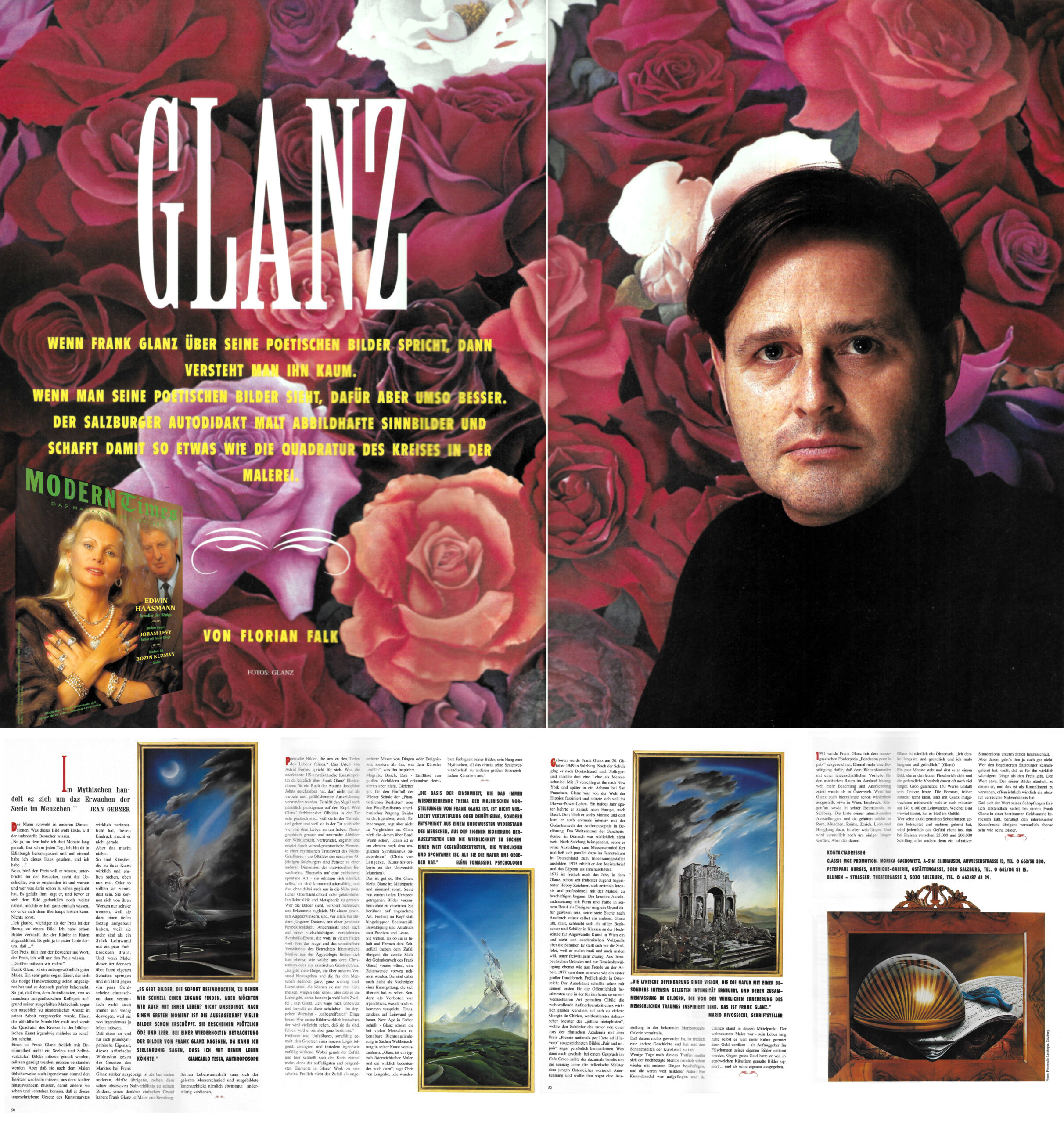
“when frank glanz expresses his poetic images, one can hardly understand what he says; yet when one observes them, they are all the more appreciable. the salzburg autodidact paints figurative, meaningful images, thus achieving something akin to squaring the circle in painting.” – by florian falk
in the mythical it is about the awakening of the soul in man — jean gebser
man floats in other dimensions. how much will this painting cost, wants to know the inexperienced visitor.
“well, i painted it for three months, almost every day, i walked around edinburgh and at some point i saw this house, and i…”
no, he only wants to know the price, interrupts the visitor, not the story of how it was born and why and who thought they saw what inside it. he likes it, he says, and even before mentally approaching the painting, he simply wants to know if he can afford it. nothing else.
“i believe that more important than the price is the relationship with an image. i have already sold paintings that the buyer paid in installments. first of all, it is about the fact that…”
the price, interrupts the visitor, the price, i just want to know the price. “we have to talk about this.”
frank glanz is an extraordinarily skilled painter. indeed, very skilled. someone who has built his own tools for the craft and yet masters them perfectly. so well that, precisely because of his refined painting technique, some contemporary colleagues have even reproached him – the autodidact – for an overly academic approach. an artist who paints figurative symbols and seems to achieve, with apparent ease, the squaring of the circle in visual art.
one thing frank glanz certainly is not: a seller of souls or of himself. the paintings must be painted, they must be shown, they must be understood. but that after their creation they must sooner or later also change owners, leave the studio so that others can see and understand them, that he has truly internalized this unwritten law of the art market, he gives no such impression. but it does not matter. this is how artists who are truly and honestly on the side of their art are. or at least how they should be. they separate with difficulty from their works, because with them they have built a deep bond, because they are more than a simple piece of canvas with some color stains.
and when painters of this type still manage to overcome their own shadow and exchange a painting for some banknotes, probably also because, after all, they have to live on something. that this characteristic, in itself entirely likeable, this stubborn opposition to the laws of the market, is more pronounced in frank glanz than in others, is probably due – besides his almost obsessive relationship with images – to a very simple reason: frank glanz is a painter out of passion. his livelihood could indeed be secured equally well in other ways, being a qualified knife smith and a certified interior architect.
“there are images that immediately strike, to which we find immediate access. but do we also want to live with them? not necessarily. after a first moment, the expressive power of many images is already exhausted. they suddenly appear empty and lifeless. in the case of repeated observation of frank glanz’s images, however, i can calmly say that i could live with them.”
giancarlo testa, anthroposophist
“poetic images that lead us to the depths of life.”
the judgment of astrid forbes speaks for itself. what the recognized us art expert has recently written about frank glanz’s illustrations for a book by author johns should not be understood merely as verbal and emotional recognition. it also perfectly hits the core of the content.
glanz’s intensely colored images are highly poetic, because they go in depth and because they really have much to do with life. representations of reality that are photographically precise and natural, distorted, integrated, and replaced by surreal-fantastic elements of a mythical dreamlike world of the ungraspable: the images of the sensitive salzburg artist are windows into other dimensions of individual consciousness.
on the one hand, spontaneously and refreshingly: they explain themselves, they are communicative, without ever sliding into embarrassing superficiality or artificial intellectuality and metaphor. those who observe these images feel both nostalgia and understanding. with a certain wink and, especially in the more recent works, with a certain irreverence.
on the other hand, however, also on a layered and condensed symbolic level, which in many cases goes far beyond the immediate eye and comprehension of the observer. one finds motifs from egyptology as well as from christianity or asian spiritual doctrines.
“there are many things that go beyond our understanding and are nevertheless extremely important to the human being. love, for example: one cannot measure it, weigh it, or see it, but that love exists is certainly not in doubt,” says glanz. “i consciously and unconsciously approach these apparently ‘incomprehensible’ things – in both senses of the word. those who truly observe my paintings may see that they are there, but they will certainly feel them.”
tangible and intangible, carefully painted, following the laws of an inner logic, arranged yet apparently random. chance – and here the circle closes again – seems to be one of the most evident and determining elements of glanz’s work. not chance as a disordered mass of things or events, but as what “happens” to the artist, what inspires him.
magritte, bosch, dalí: influences of great masters are recognizable, but not dominant. the same goes for the viennese school of “fantastic realism” or american photorealism. everything is present, in some way evokes memories but does not invite comparison. glanz throws the isms overboard. if anything, “it is at most reducible to magical symbolism” (chris von lengerke, art historian at the university of munich).
and it is right this way. in glanz, glanz remains at the center, and no one else. his images, supported by a profound original knowledge, enchant without confusing. they touch pleasantly. freedom in the mind instead of external soul garbage. elaboration and expression instead of problem and emptiness.
they seem to anticipate, in content and form, the spirit of the time – alongside chance, the second main pillar of frank glanz’s thinking – as if they prefigure a turning point. they should not be considered as latecomers of an already outdated artistic genre, but as messengers of something yet to come.
transcendence fixed on canvas, new age wrapped in colors: glanz seems to intuit in his art the change in direction, today perceptible in many people, in the way they look at the world.
glanz is a typically austrian painter, and moreover truly significant,” says chris von lengerke. “the wonderful colorfulness of his works, his inclination to the mythical: all this expresses his spiritual affinity with other great austrian artists.”
“the basis of solitude, which constitutes the recurring theme of frank glanz’s pictorial representations, is not perhaps despair or humiliation, but arises from an unconscious resistance of man to leave his isolation and seek reality, to confront a world more real and more spontaneous than what nature has given us.”
eléne tomassini, psychologist
biography
frank glanz was born on october 20, 1949, in salzburg. after school he moved to germany, in solingen, where he began an apprenticeship as a knife smith. at 17 he found himself in new york and later in an ashram near san francisco. glanz was fascinated by the hippie world and fully immersed himself in the flower power lifestyle. six months later he returned to europe, to basel. he stayed there for six months and came into first deep contact with the anthroposophy movement. the world center of this movement, in dornach, was not far.
back in salzburg, he continued training as a knife smith and simultaneously trained as an interior designer through a distance course in germany. in 1975 he achieved the title of master and the diploma of interior architect. 1975 is also the year in which glanz, already a passionate draftsman from early childhood, began to devote himself intensely and professionally to painting. the creative confrontation with form and color in his designer work may have been one reason, the constant search for self-expression another.
glanz paints, enters as a silent observer and student in the classes of the university of applied arts vienna, and watches established academics work. he stands in front of the easel because he must paint and because he wants to paint, under a sort of voluntary constraint. for therapeutic and existential processing reasons, as well as for the pure pleasure of working.
in 1977 came something like a first major turning point. not in austria, though: with his first oil painting for the public, made in the style that makes him unmistakable today, the autodidact managed to attract the benevolent attention of a truly great artist. giorgio de chirico, the famous italian master of “metaphysical painting,” wanted to personally meet the author of the painting “pair and un-pair,” awarded by a jury of the roman academy with the “national prize for art and work.”
the meeting took place: during a conversation at caffè greco, the italian master, then already close to ninety, expressed wide recognition to the young austrian and even wanted to mediate an exhibition in a renowned gallery. that it did not actually take place is another story, related to the dark sides of the art world. a few days after that meeting, the venerable mentor was in fact involved in much more delicate matters: an artistic scandal had erupted, and de chirico was at the center. the famous painter was exposed as a commissioner of forgeries of his own works. for payment, he had other artists make paintings and sold them as his own.
“the lyrical revelation of a vision that renews nature through an interiority lived with particular intensity, and its synthesis in images inspired by the true rebirth of the human dream: this is frank glanz.”
mario rivosecchi, writer
awards and artistic work
in 1991 frank glanz was awarded the senegalese support prize “fondation pour la paix.” once again, a confirmation that the citizen of the world, with a marked preference for the asian cultural space, received much more attention and recognition abroad than in austria. even in his homeland glanz exhibited widely, in vienna, innsbruck, klagenfurt and in his native salzburg. the list of his international exhibitions – including rome, munich, reims, hong kong – is far longer, and will probably continue to grow. but this requires time.
glanz is an oil painter. “i think slowly and in depth, and i paint slowly and in depth,” he says. he works for months on a single painting before applying the last brushstroke, and the mental preparation often lasts even longer. his work today comprises about 150 pieces. the formats, once predominantly small, grew with him: today he also paints on canvases of 140 × 160 cm.
the price of each painting is simply in his feeling. those who observe his creations painted with extreme precision and can calculate, can hardly ignore the fact that, with prices ranging from 25,000 to 200,000 schillings, the result certainly does not correspond to a profitable hourly wage. but that is not the point. those who have known the enthusiastic salzburg artist know that for him there are things far more important than price. value, for example. that of his works, with which – and this should be understood as a compliment – he clearly maintains an absolutely crazy proximity relationship.
that the value of his creations can, ultimately, be measured also in a certain sum of money, probably reassures the interested art lover as much as the works themselves.
contacts
classic image promotion, mom gachowetz
a-5161 elixhausen, auwiesenstraße 13
tel. +43 662 58 38 0
peterpaul burges, anthme-galerie
gstättengasse, 5020 salzburg
tel. +43 662 84 81 15
blumen-strasser
theatergasse 2, 5020 salzburg
tel. +43 662 87 42 29
article appeared in: times magazine – das magazine zur eurocard, issue 1 – 1993, pp. 51–53